
A WikiGacha alternative built for trading
WikiGacha turned Wikipedia into a gacha game. Lexicodex starts from the same idea, opening packs of articles and chasing the rarest, and takes it multiplayer: an auction market, trades between players, albums and duels refereed by an AI.
Free, in the browser, from the makers of Tusmo, and you don't start from scratch: your WikiGacha collection comes with you. Made in France, playable in English: the game opens in your browser's language, and switches to French in its settings.
Free · in the browser · no account to start
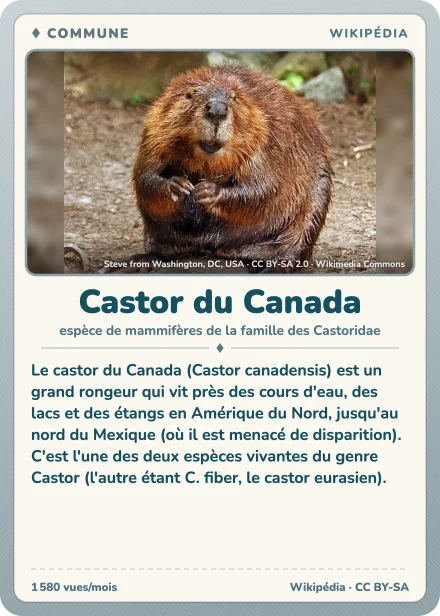
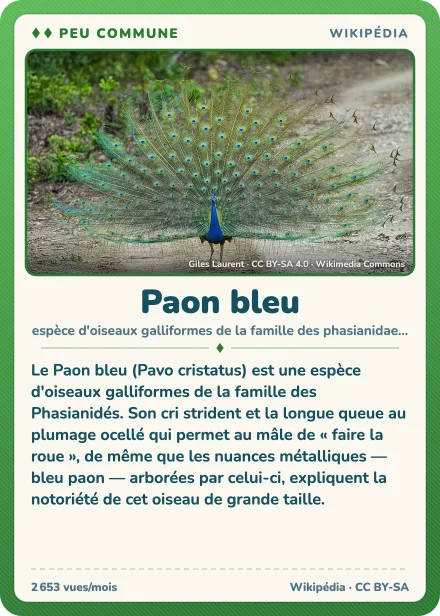
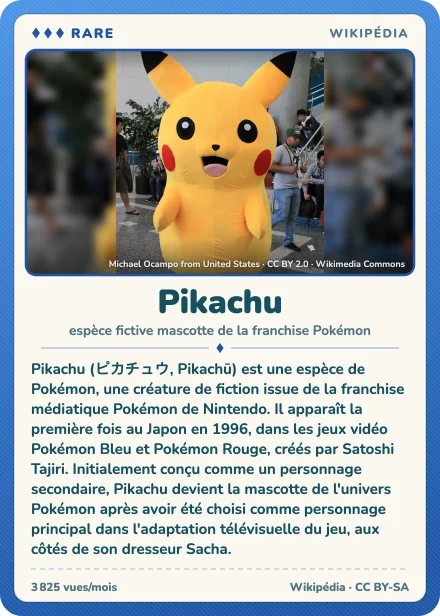
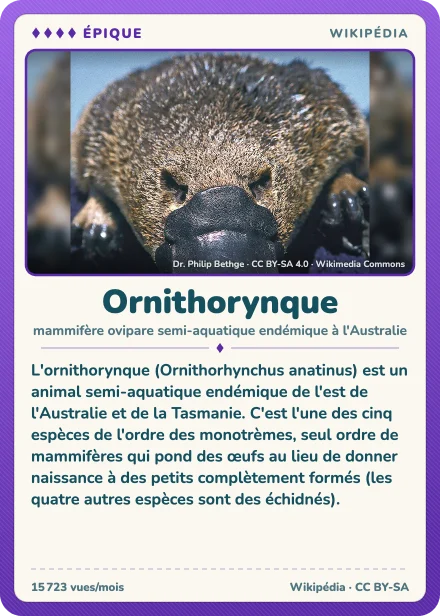
Your WikiGacha collection comes with you
WikiGacha keeps your collection in your browser, and lets you export it to a backup file. Lexicodex reads that file and rebuilds your cards, in a minute, on a computer or a phone:
- Create your Lexicodex account (email, Google, Discord, or your Tusmo account).
- On WikiGacha, Collection page, local backup section: Export. Pick a passphrase; WikiGacha saves a .wgbak file.
- On the Import page, drop that file and type your passphrase.
- Your cards show up, rarest first; confirm the import with a long press.
The backup is decrypted in your browser: your passphrase never leaves the page, Lexicodex only receives your article titles, and nothing changes on your WikiGacha side. Articles from English and French Wikipedia are brought over (not WikiGacha's other languages), up to 10,000 cards, rarest first.
Every article found becomes a Lexicodex card, at Lexicodex's rarity (set by readers, not by the article's quality: a WikiGacha SSR won't necessarily land as mythic), in the standard finish. These cards are bound to your account: you can show them, file them in albums and decorate them, but not sell or trade them. Articles Lexicodex doesn't have are worth one drop of ink each, up to 1,000, paid after your first 100 packs.
WikiGacha and Lexicodex: what's different
Both games draw their cards from Wikipedia articles and play free in the browser. They part ways on how a card's value is set, and on what you do with it afterwards.
| WikiGacha | Lexicodex | |
|---|---|---|
| Origin | Japan, released February 24, 2026 | France, from the publisher of Tusmo |
| Language | Several Wikipedia editions | English and French Wikipedia (nearly 2.9 million articles); words in English and French |
| Rarity | The article's quality score (WikiRank's Q-Score) | The article's traffic, as a twelve-month median |
| Packs | 5 cards, one a minute up to 10, an SR-or-better pack every 10 | 5 cards, one every 10 minutes, 10 in reserve |
| Battles | Attack (pageviews) and defense (article length), 5-card decks, raids | No stats: one theme per round, and an AI judges which card fits it best |
| Market between players | - | Auctions and buy-now, in ink |
| Trades between players | - | Up to 20 cards on each side |
| Bring over a WikiGacha collection | - | Yes, from its backup file |
Rarity that follows the readers
In Lexicodex, the more an article is read, the rarer its card. We take the median of its monthly views over twelve months: a month of news doesn't make a mythic, a page everyone reads all year round does. The tiers, for English Wikipedia:
- Mythic: over 150,000 views a month, about 1,400 articles (Taylor Swift, Napoleon, Minecraft…)
- Epic: over 48,000, about 10,200 articles
- Rare: over 15,600, about 41,900 articles
- Uncommon: over 9,300, about 42,600 articles
- Common: every other article above 200 views a month, about 1.8 million of them
French Wikipedia, read about ten times less, has its own thresholds: mythic from 25,000 views a month.
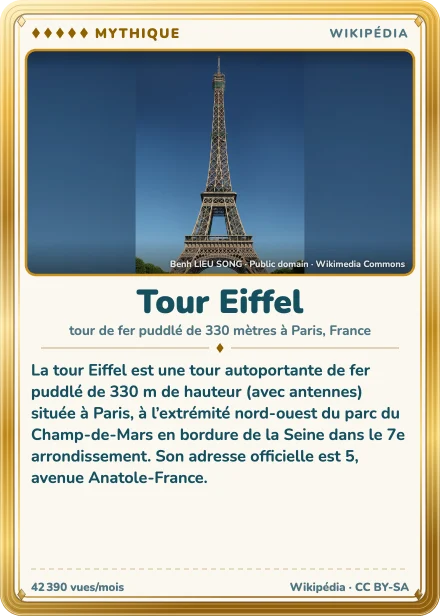
Each copy also gets its own finish, drawn separately from its rarity: standard, reverse, holo, cosmos or prism, and sometimes neon, a black card where the picture's outlines light up as tubes. About one pack in four holds a special card; one in sixteen a holo, one in two hundred a prism. A prism neon Eiffel Tower is a different card from a standard one, and the market knows it.
Collecting together
3D cards in five finishes
Every card flips, shines and tilts under your finger. On top of its rarity, a copy can come out reverse, holo, cosmos or prism, and neon: the card turns black and its picture's outlines light up as tubes.
Duels of wit, not trivia
Build a deck of 50 cards and take on another player over 3 rounds. Each round sets a theme, say "Would make the worst birthday present": you have 30 seconds to play the card from your hand that fits it best, and Lexi, the referee (an AI), scores both cards out of 100. A cheese fondue can beat Napoleon.
Two games in one: Wikipedia and the dictionary
Next to the articles sits a second game of word cards: each word's Wiktionary entry, in French or English, with its definitions and pronunciation. Both share your booster reserve and your ink.
A market and player-to-player trades
Put your duplicates up for auction, with an optional buy-now price, on the market. Or offer a trade to a friend: up to 20 cards on each side; they accept, decline or counter, and the cards travel from one phone to the other in a small 3D scene.
The forge, for the card you're missing
Recycle cards into ink, then spend it at the forge to craft any card in the game, even one you never pulled, or to upgrade a copy to holo, cosmos or prism.
Albums, showcase and Almanac
Sort your cards into themed albums you can share with a link, show off your best three on your profile, climb the leaderboards, and look up any article in the Almanac: its rarity, how many copies exist, who owns them.
Frequently asked questions
Is Lexicodex free?
Yes. You get one 5-card booster pack every 10 minutes, up to 10 in reserve, without paying anything. The membership (€4.99 a month, or €39.90 a year) refills the reserve every 5 minutes and adds 3 Member packs a day; ink and stickers can be bought too. None of it is needed to play.
Do I need an account?
Not to try it: your first 10 packs open without one. After that, an account keeps your cards and unlocks the market, trading and duels: an email address, Google or Discord will do.
Will importing cost me my WikiGacha collection?
No. Lexicodex only reads the backup you exported: nothing changes on WikiGacha, you can keep playing there.
I forgot my passphrase. What now?
It isn't stored anywhere, neither at WikiGacha nor with us: export a new backup from WikiGacha, with a passphrase you'll remember.
Is Lexicodex available in English?
Yes. The game opens in English if that's your browser's language, and you can switch between English and French in its settings. Cards come in both languages too: articles from the English and French Wikipedias, words from the English and French Wiktionaries.
Does it work on a phone?
Yes, in the browser, with nothing to download, and it installs like an app on your home screen, on Android and iPhone alike.
Where do the cards come from?
The texts come from Wikipedia and Wiktionary (CC BY-SA 4.0 license), the pictures from Wikimedia Commons. Every card links to its article and credits the author of its picture. Lexicodex is not affiliated with the Wikimedia Foundation.
Is Lexicodex affiliated with WikiGacha?
No. Lexicodex is an independent game published by Tusmo; it is affiliated with neither WikiGacha nor the Wikimedia Foundation.
Your first pack is waiting
Five cards, right now, no account needed.
Updated on .
Cards: texts from French Wikipedia (Castor du Canada, Paon bleu, Pikachu, Ornithorynque, Tour Eiffel), CC BY-SA 4.0 license; pictures from Wikimedia Commons: Castor du Canada (Steve from Washington, DC, USA · CC BY-SA 2.0), Paon bleu (Giles Laurent · CC BY-SA 4.0), Pikachu (Michael Ocampo from United States · CC BY 2.0), Ornithorynque (Dr. Philip Bethge · CC BY-SA 4.0), Tour Eiffel (Benh LIEU SONG · Public domain).


